
During Sprint Planning, one of the team members facilitating the session still unclear with the requirements, even though management has already locked the release deadline for a new product. This product is critical because it will allow the company to stay competitive, reduce costs, and ultimately boost revenue.
Despite the uncertainty, the Scrum Team should not see this as a barrier. Instead, it becomes an opportunity to focus on fostering transparency, understanding the purpose of the work, and ensuring healthy collaboration. To adapt to the situation, the Scrum Team needs to answer several key questions: What is the next goal of product development? Are the increments the team has made aligned with stakeholders’ expectations? And does the team understand its capacity to achieve a meaningful goal in this Sprint? By addressing these questions, the Developers can establish an initial plan with more clarity and purpose.
Avoiding Low-Value Sprint Goals
In my experience facilitating Scrum Teams, using metrics based on Evidence-Based Management (EBM) can foster collaborative conversations. Rather than relying on guesswork, the Scrum Team should validate decisions using data and evidence. These evidence aren’t just for internal team consumption; they should also be shared with stakeholders for early feedback. Doing so enables the team to decide when to release features or prioritize the most important Product Backlog Items (PBIs) before the Sprint begins.
However, when deadlines are tight and requirements remain unclear, Scrum Teams risk overcommitting or delivering low-value increments by compromising on the Definition of Done. In situations like these, effective facilitation becomes essential to ensure the team’s focus remains on delivering purposeful outcomes. According to Facilitating Professional Scrum Teams by Patricia Kong, Glaudia Califano, and David Spinks, here are some ways to avoid ending Sprint Planning with a low-value Sprint Goal:
- Uncover everyone’s point of view
As a facilitator, use open-ended questions to ensure everyone can voice their concerns. This ensures all perspectives are considered and contributes to transparent decision-making. - What Does the data Say?
Past performance data, user feedback, and sales metrics can help prioritize PBIs. These tools spark meaningful conversations and help the team make better-informed, purposeful decisions. - Facilitate discussion on what’s most important
To avoid focusing solely on how many PBIs can be delivered, facilitators should ask, “What are the most important PBIs to start next?” This helps the team craft a valuable and purposeful Sprint Goal, aligned with the broader objectives.
Transparency in Decision-Making
As competition shifts and customer challenges evolve, stakeholders’ priorities may change. It’s crucial that the Scrum Team builds communication channels to stay aligned with stakeholders. Scrum is designed to handle complex problems where more is unknown than known.
“Artifacts with low transparency lead to decisions that diminish value and increase risk. Transparency enables inspection. Inspection without transparency is misleading and wasteful.” – Scrum Guide
Transparency is also the cornerstone of effective Scrum facilitation. By understanding stakeholders’ needs—not just their wants—the Scrum Team can focus on delivering valuable products rather than getting bogged down in less critical tasks. This also ensures the work remains purposeful.
Transparency thrives when people share the information they have. In my experience, regular quarterly product alignment sessions help both the Scrum Team and stakeholders share expectations. Using a divergence and convergence approach to facilitate discussion it would effectively leverage diverse perspectives. Start by listing various stakeholder initiatives (divergence), then explore and consolidate the most impactful initiatives for the next quarter (convergence). This approach ensures that everyone’s perspective is considered, and the team can collectively agree on the path forward.
Prioritization for Healthy Collaboration: White Elephant Technique and RICE Scoring Model
Prioritizing work in a healthy, collaborative way can often be challenging when there are competing interests. To facilitate this, tools like the White Elephant technique and the RICE scoring model can be particularly useful.
White Elephant Technique
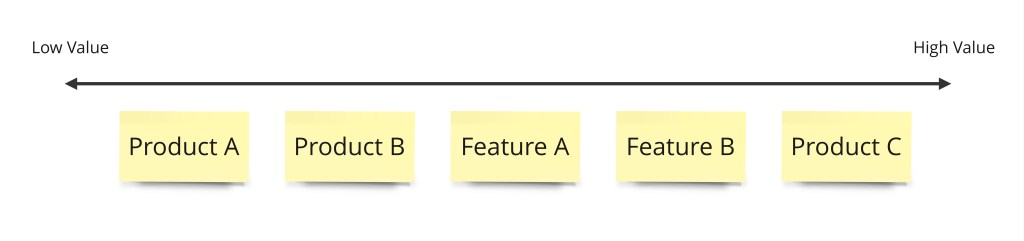
This method involves visually categorizing ideas, requirements, or backlog items based on their value. By plotting ideas on a single matrix—with a sliding scale that gives some indication Least Effective to Most Effective or Low Value to High Value —the team can clearly identify which items might be “white elephants” (low value, high complexity) and focus on tasks that offer the most benefit. This technique helps the team make transparent and purposeful decisions on what to prioritize.
RICE Scoring Model
Another powerful tool for prioritization is the RICE scoring model, which stands for Reach, Impact, Confidence, and Effort:
- Reach: How many users or customers will be affected by this feature within a given timeframe?
- Impact: How much improvement will this feature bring to users or the business? It can be rated on a scale (e.g., minimal, low, medium, high, or massive impact).
- Confidence: How certain are we that our estimates for Reach and Impact are accurate? If these estimates are speculative, the confidence level may be low.
- Effort: How much time and resources will this feature require? This is typically measured in person-hours, weeks, or sprints.
Based on my experience with Scrum Teams using the RICE model, every feature or initiative desired by the stakeholders is scored by combining factors such as Reach (number of transactions), Impact (the initiative’s impact according to the stakeholder), Confidence (clarity of specification details or supporting documents), and Effort (estimated number of Sprints from the Developers). Features or initiatives with higher value and relatively lower effort typically receive higher scores, making them more likely to be prioritized. The results of this prioritization are then presented to the stakeholders to ensure transparency and alignment with their needs.
We often use the White Elephant technique to validate and refine these priorities, either with stakeholders or within the Scrum Team, before finalizing them. This approach allows the team to visualize complexity and value more effectively, encouraging collaborative discussions about whether certain PBIs deserve a high ranking or if they need to be re-evaluated based on additional information known only to the stakeholders.
Feedback Fuels Purpose and Growth
Although Scrum events focus on inspection and adaptation, Scrum Teams are not limited to gathering feedback only during those events. I have seen Scrum Teams successfully engage with stakeholders outside of formal events whenever needed. This continuous collaboration ensures that the Scrum Team understands the rationale behind product development and fosters a sense of responsibility to deliver valuable and meaningful products.
For instance, in one of the Scrum Teams I know, the developers were trying to balance regulatory policies with the users’ need for a simple and user-friendly application flow. Surveys and interviews conducted during the Sprint revealed insights that eventually helped them design a smoother application flow without violating regulatory policies. The ability to continuously gather stakeholder feedback empowered the developers to improve product.
Another example is when a Scrum Team’s Sprint Goal is to release a new product. The developers can conduct a Production Validation Test followed by a canary release. During this process, they gather feedback from stakeholders and users to assess the impact of the limited release version. Some minor changes or fixes may occur during the release stabilization period before the full release. As long as the Sprint Goal remains relevant, it serves as the team’s “North Star,” guiding decisions throughout the Sprint.
Achieving Transparency, Purpose, and Healthy Collaboration
As Scrum Teams navigate the complexities of product development, especially under tight deadlines and unclear requirements, the importance of transparency, data-driven decisions, and stakeholder alignment are essential to clarify the situation. A transparent, purposeful, and healthy facilitation approach can help foster a shared understanding within the team and with stakeholders. However, as we continue to refine our approaches, it’s also important to reflect: Are we truly focusing on delivering what’s most valuable to our customers, or are we still getting caught in tasks that don’t move the needle? How can we further enhance collaboration and transparency to ensure that every Sprint delivers meaningful progress toward the Product Vision?

 #annalogy